
June
04
2026
19:16

June
04
2026
19:16
Microplastics all around us
James writes about the latest microplastics pollution research and what this means for our farm in Zsámbok
Microplastics
A Hungarian friend in the USA who works for a large environmental investment group has been researching microplastics. These are his conclusions.
Microplastics are impacting the world’s biology in the following ways:
- Durability. Microplastics last hundreds to thousands of years, some forever.
- Bioavailability. Microplastics are the ideal vector for plastic, chemicals, and heavy metals to enter living species.
- Bioaccumulation. Microplastics mostly stay in organisms' systems, so dosage accumulates over time.
- Biomagnification. Microplastics move up the food chain from plankton to highest concentrations in predator fish.
- Intergenerational transfer. Microplastics transfer directly from fish to roe, from mice to offspring, from adult female humans to babies.
- Plant uptake and transfer. Nano-scale microplastics move into plants, then into seeds and fruit, then are found in fruits in the food system.
- Toxicity. Microplastics cause physical blockage and scarring, inflammation, oxidative stress, DNA alteration, and chemical/heavy metal poisoning.
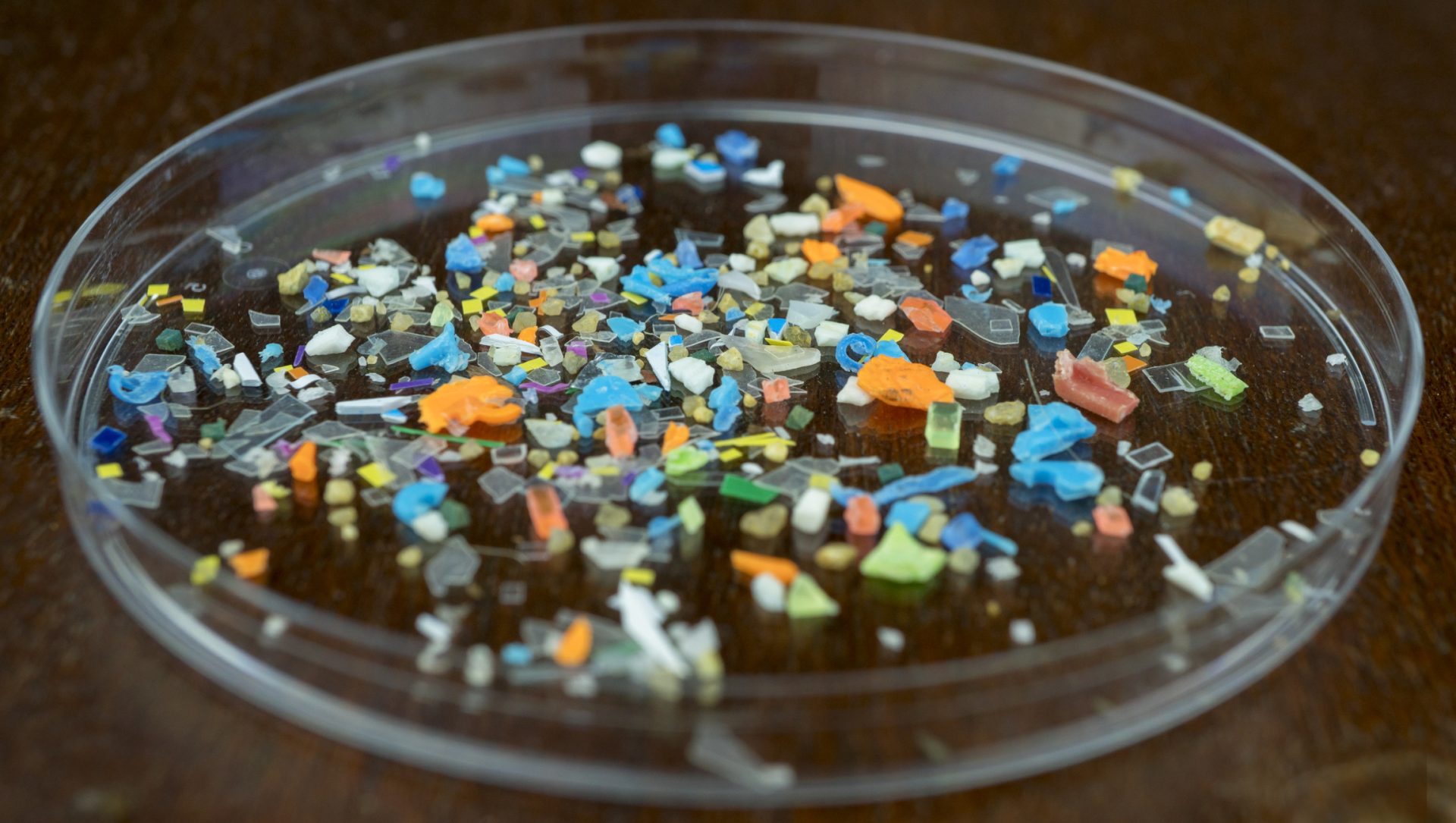
Levels in coastal areas and seas, agricultural soil, wetlands, and rivers are already impacting species. Levels in the environment are increasing exponentially.
Microplastics are impacting species at population level. For fish: reduced growth, survival, reproduction. For insects: reduced survival, growth, development, feeding, fecundity, behaviour. For plants: decreased biomass, chlorophyll content, crop growth and quality, increased oxidative damage.
Not fun.
Yes: Agricultural soils
What was that a few paragraphs up? “Agricultural soils.” I dug into it a bit more.
It turns out if you walk around a typical market garden, plastic is almost everywhere. Mulch film is laid over beds to suppress weeds, warm the soil and hold moisture. Polytunnel and greenhouse glazing hold in the warmth. Fleece and row-covers nurse early crops. Drip irrigation tape is threaded along every bed. Plug trays, modules and pots are used in the propagation house. Then there’s twine, clips, netting and weed fabric, and all the packaging downstream once the produce leaves the farm.
Mulch film is the big one
Globally, plastic mulch covers more than 25 million acres of farmland and puts 6.7 million tonnes of non-biodegradable material into the ground every year. It is the single biggest contributor to agricultural plastic pollution — not packaging, not the odd bit of litter, but the sheeting we lay down to grow crops.
When you lift mulch film at the end of the season it becomes brittle and tears, and flakes and shards stay behind in the soil. Then sunlight and microbes go to work on the fragments, breaking them down into ever-smaller pieces. Microplastics are anything under five millimetres, but the breakdown continues well below that.
In farmland in China, researchers have measured an average of around 4,500 plastic items per kilogram of dry soil, overwhelmingly from mulch film. Microplastic concentrations in soils run several times higher than in the oceans — between four and twenty-three times. We tend to picture plastic pollution as a marine problem. Not so.
There is a second problem. Films don't only shed particles; they leach out the chemicals built into them — plasticisers such as DEHP and bisphenol A — directly into the soil. Biodegradable is not much better. One 2025 study estimated the chemical load from biodegradable films to be eleven times higher than from conventional polyethylene. Biodegradable is not harmless.
But isn't it falling out of the sky anyway?
Microplastics fall as a fine, invisible rain almost everywhere on Earth. More than a thousand tonnes a year settle on America's protected wilderness alone, from cities hundreds of miles away; it reaches the high Pyrenees and the Arctic. Nowhere escapes.
But on a field that uses plastic mulch, that background rain is dwarfed by what's coming off the sheeting. The atmospheric dose is real but diffuse; the mulch is concentrated and right where the roots are.
Does it get into the food?
In 2025, researchers at the University of Plymouth showed for the first time that the very smallest particles — nanoplastics — cross the root's natural filtering barrier and accumulate in the parts of a vegetable we actually eat. In radishes, about a quarter of the absorbed particles reached the edible root and a tenth made it into the leaves.
The pathway is not hypothetical. Plastic in the soil can end up inside the crop.
What about Zsámbok?
At Zsámboki Biokert this is the situation.
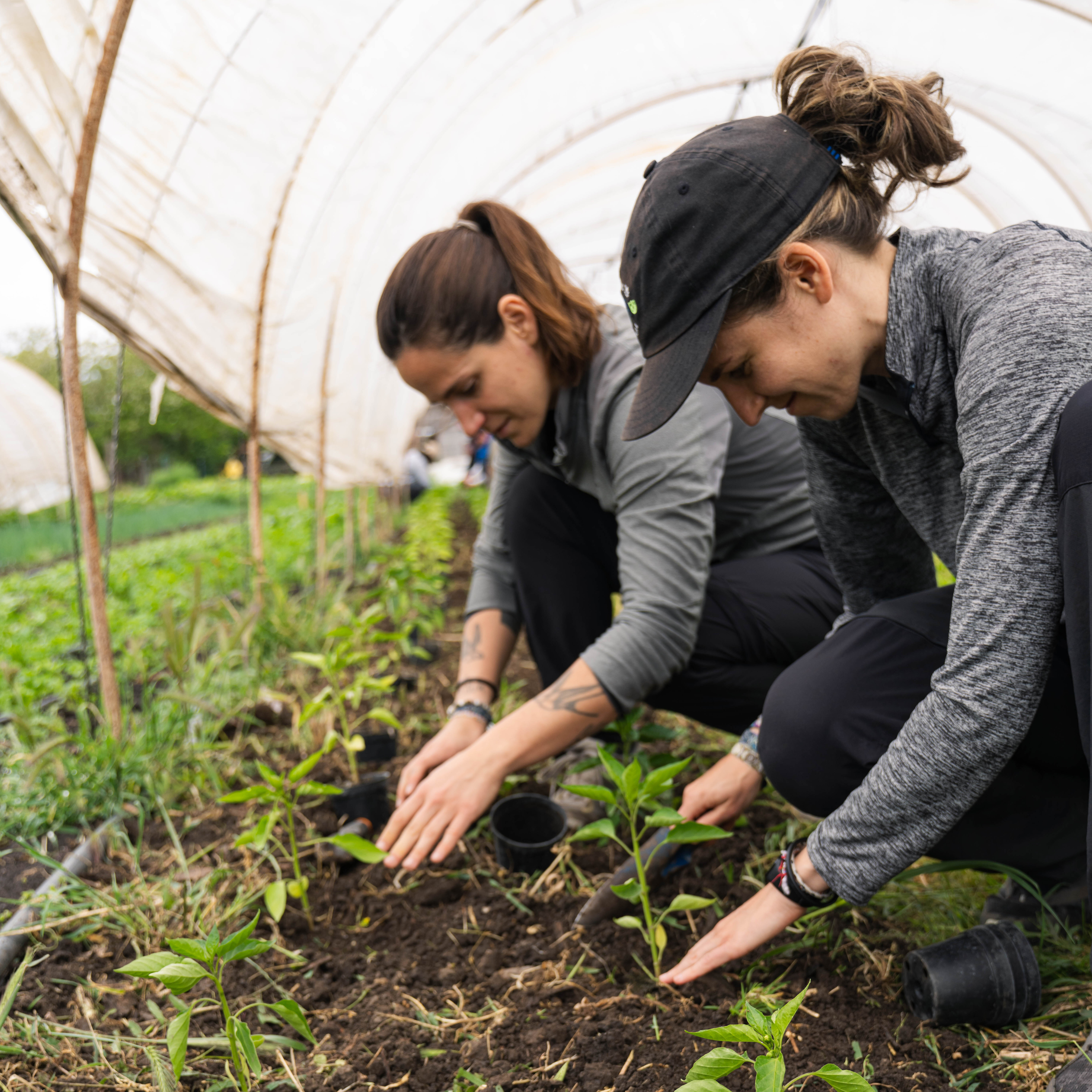
The good news is we do not work with plastic mulch. We rely on the older, slower methods: straw and woodchip mulches, living mulches and cover crops, and a lot of hand weeding. Cover crops smother weeds, feed the soil, and break disease cycles. They leave nothing behind that we'll be picking out of the ground in ten years' time.
This is not cost-free. Hand weeding is labour, and labour is the thing a small farm has least to spare. When we weigh the convenience of a roll of film against what it leaves in the soil the trade comes out clearly enough for us.
Unfortunately this does not mean we are plastic-free yet. Here’s a run-down.
Compost. By making our own compost we are confident that we end up with a compost with lower microplastic burden than commercially bought compost. If we wanted to improve on this further, we would need to reduce farm-yard manure purchases, by raising our own livestock.
Polytunnels. We do use plastic sheeting on our tunnels. It is a necessary compromise if we want to have greens in late autumn, early winter and early spring. It helps a little to buy high quality, long-life sheeting. The sheeting has limited contact with soil.
Fleeces (takarófátyol). We use this and it is tricky to avoid if we want to maximise on extending the season. One area we can improve on is sourcing higher quality fleeces.
Drip tape. We use this but it brings such an improvement on water use that we think it justifies the plastic burden. A job to do is to find a way to lobby for better agricultural recycling infrastructure.
Modular trays. We are at the beginning of the journey to replace these with soil blocks.
Pots. We use plastic pots. We will invest in higher quality pots. If we introduced a deposit on pots sold at the market, would our customer be ready to pay it? Please let us know.
Twine. Where practical we use hemp twine, but for most purposes it is not strong enough. So we still need to find a viable solution for this. We have tied up tomatoes with hemp twine but it did not work out.
Packaging. We’re using some biodegradable plastic bags for wet salad, in our boxes and in the market. So far we have not got a better solution.
In summary: we completely avoid mulch sheeting which is by far the most important source of microplastics in agricultural soil. Inspired by what we have learned recently on microplastics, we are putting together a plan to replace wherever possible with natural materials and, if that’s not possible, upgrade the plastic quality to reduce wear.
Overall
By completely avoiding plastic mulch, we believe that our plastic performance is significantly better than the average market garden, both conventional and economic.
The soil we farm is not really ours. We borrow it for a while and hand it on. We'd rather hand on soil, without plastic mixed up in it.
Our first priority is to continue to make the food we supply you as healthy as possible.
Sources for the figures above, for anyone who wants to read further: the 25-million-acre / 6.7-million-tonne mulch figures are from a 2024 PNAS Nexus study on plasticulture; the ~4,500 items/kg Chinese farmland figure and the 4–23× soil-vs-ocean comparison from Science of the Total Environment (2024); DEHP and additive leaching from Environmental Pollution (2024); the biodegradable-film additive comparison from a 2025 Journal of Hazardous Materials study; atmospheric "plastic rain" figures from Brahney et al., Science (2020); and the radish nanoplastic uptake from the University of Plymouth (2025).